
Trailing Round With Dickens: An Enthusiast’s Guide To Broadstairs
This post is contributed by Carolyn Oulton, Professor of Victorian Literature at Canterbury Christ Church University. Carolyn's recent publications include Down from London: Seaside Reading in the Railway Age (Liverpool University Press 2022) and Books In All The Right Places: Reading Culture and the Victorians (forthcoming from Princeton University Press). She teaches on the Creative Writing BA at CCCU and is Project Co-Lead with Dr Michelle Crowther for both Kent Maps Online and ‘Let’s do the time walk again! Exploring the East Kent Coast Through Digital Heritage’ (funded by the National Lottery Heritage Fund). Her new poetry collection The Letter Game is forthcoming from Worple Press.
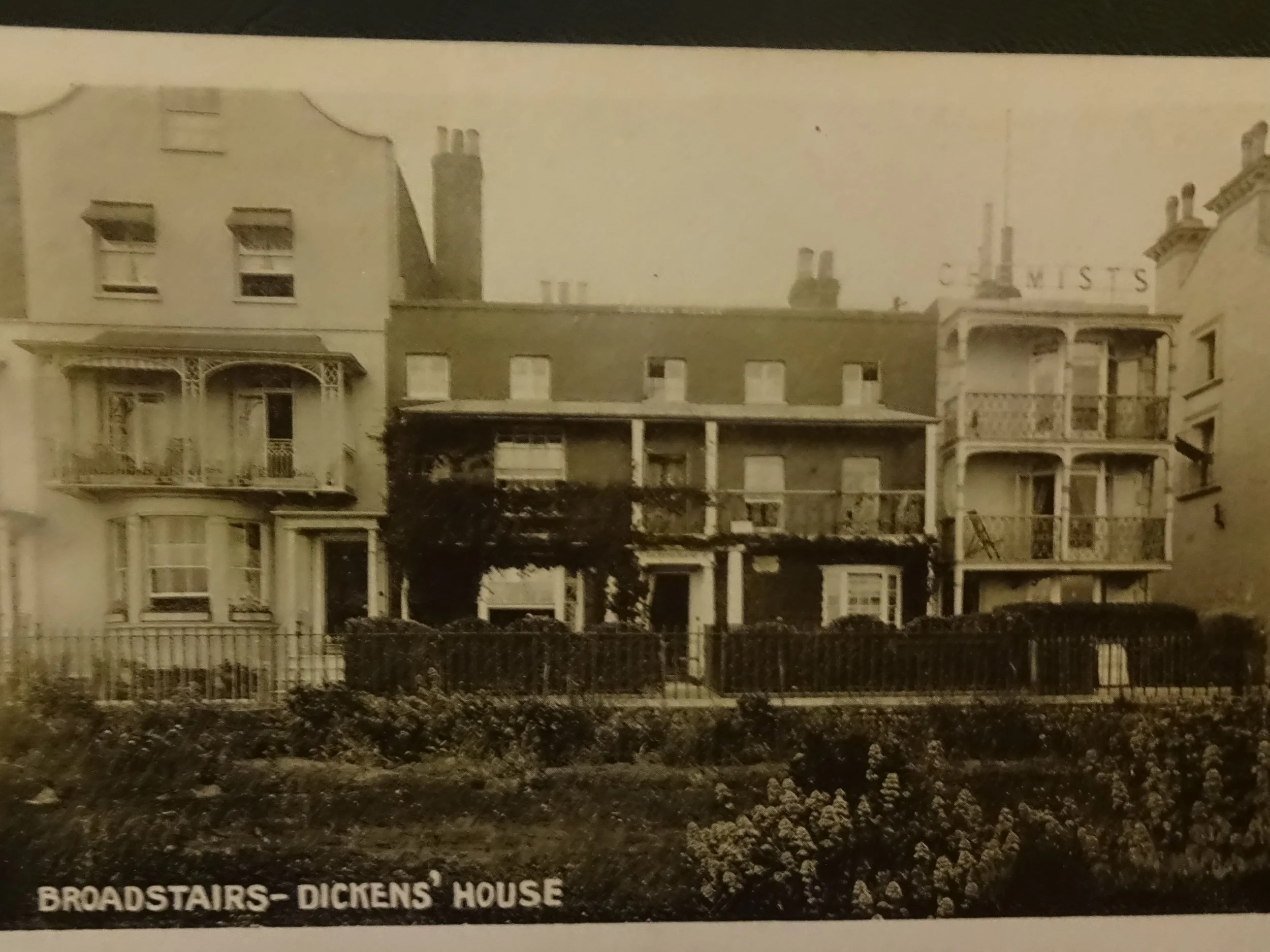
2 Nuckell’s Place was renamed Dickens House in the 1890s.
Over the years, the Dickens Industry has taken many forms: dramatic and film adaptations, fan clubs and reading projects; it has galvanised a trade in memorabilia of all kinds, from birthday books to cigarette cards. The Dickens Fellowship was inaugurated in 1902 and the Dickens Society in 1970. There are no fewer than three Dickens Museums in the UK: in Portsmouth, London and Broadstairs; as well as two annual festivals, in Rochester and Broadstairs. In the early 2000s, the commercial attraction Dickens World, based in Chatham, invited guests to wander through a Victorian town. In the early days, it was also possible to sail down an artificial river and encounter Magwitch and other figures from the novels.
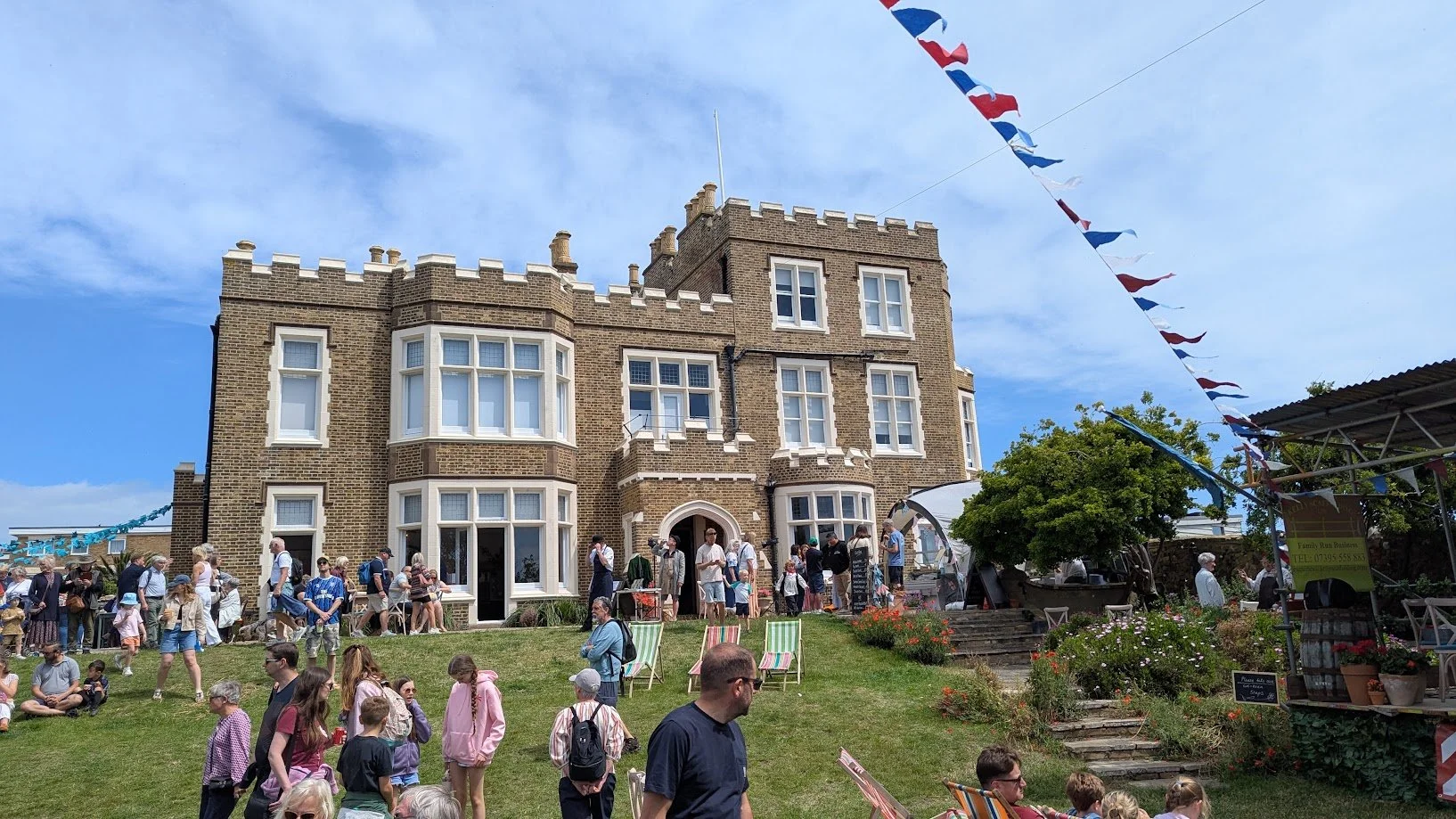
Bleak House, Broadstairs Dickens Festival 2026.
The desire to see for oneself – better still, to touch – lies at the heart of Dickens tourism. In 1880 the writer and journalist Thomas Frost published a book titled In Kent With Charles Dickens. In what would become a familiar motif, he recounts a holiday with two friends visiting ‘the numerous localities associated with incidents in Dickens’s inimitable and immortal works.’ (4) Towards the end of the holiday they find themselves in Broadstairs, where Frost registers Lawn House (later Arch House) as the place where Dickens wrote part of The Old Curiosity Shop. In 1891 William Hughes remembered in A Week’s Tramp in Dickens Land that he and Frederick Kitton had had some difficulty locating this house. They finally adopted the sensible plan of simply approaching the oldest-looking resident.
But if finding Lawn House had proved confusing, this was would remain the least of the visitor’s problems. Fort House was one highly visible marker of the author’s presence in the town. It had been informally known as Bleak House since at least 1864, leading to an understandable assumption that the book itself had been written there. Somewhere between 1883 and 1885 the name was formally changed, which helped to perpetuate the mistake.
A short distance away, 2 Nuckell’s Place was confirmed by Charley Dickens as the original inspiration for Aunt Betsey’s cottage (which Dickens places in Dover, in David Copperfield). It was renamed Dickens House in the 1890s in tribute to the novel, but it only took one typo on a postcard to suggest that Dickens himself had lived here.
From the end of the Victorian period, Broadstairs was strategically marketing its Dickensian connections through postcards, guide books and festivals. In 1897 Alfred Harmsworth (founder of the Daily Mail) was one of the organisers of a ‘Dickens Village’, which recreated scenes including Defarge’s wine shop, Peggotty’s boat, the Great White Hart at Ipswich and the Old Curiosity Shop. The festival was successful enough to be repeated the following year.
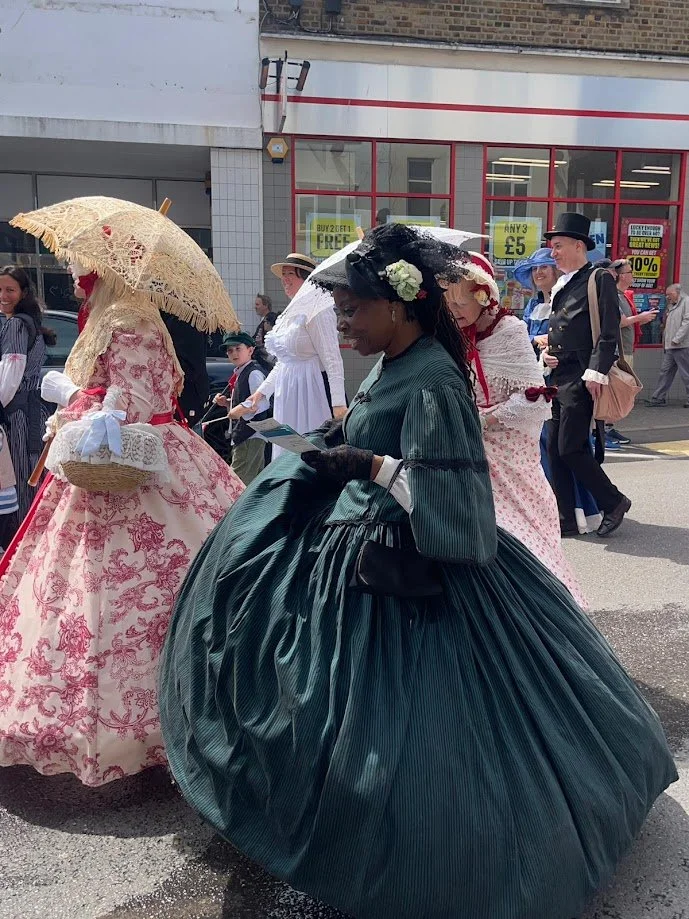
Broadstairs Dickens Festival 2026.
In the 1930s Dickens House fittingly became the home of the author and dramatist Gladys Waterer. One of the founding members of the Broadstairs branch of the Dickens Fellowship, Waterer also adapted a play every year for the Dickens Festival relaunched in 1937. She took parts including Mrs Squeers from Nicholas Nickleby and was responsible for introducing donkeys into the cast of David Copperfield.
The 1987 festival had relied on local residents lending their own mementoes and Dickensiana. But by the 20th century the instinct to touch literary artefacts was increasingly counteracted by awareness of their fragility. Fans were encouraged to buy merchandise instead. In a 1969 Elizabeth Bowen novel, two characters meet in Bleak House in Broadstairs, and reflect on the writer’s importance as a cultural icon, ‘Commemorated in ashtrays, cream-jugs’ (Eva Trout, 113) as well as new editions of his books. The iconoclast Eva sits in Dickens’s study chair, in defiance of the customary rope.
The desire to go to a place, and imagine oneself into the author’s presence, persists in the 21st century. The Broadstairs Dickens Festival creates a carefully orchestrated palimpsest, as locals dress in Victorian costume and parade incongruously through the town. But silent film, as well as slides held by the Dickens House Museum, show the event itself becoming part of the historic record. Digital technologies allow us to interact with the tangible environment in new ways – and at their best, they encourage us to see it differently.
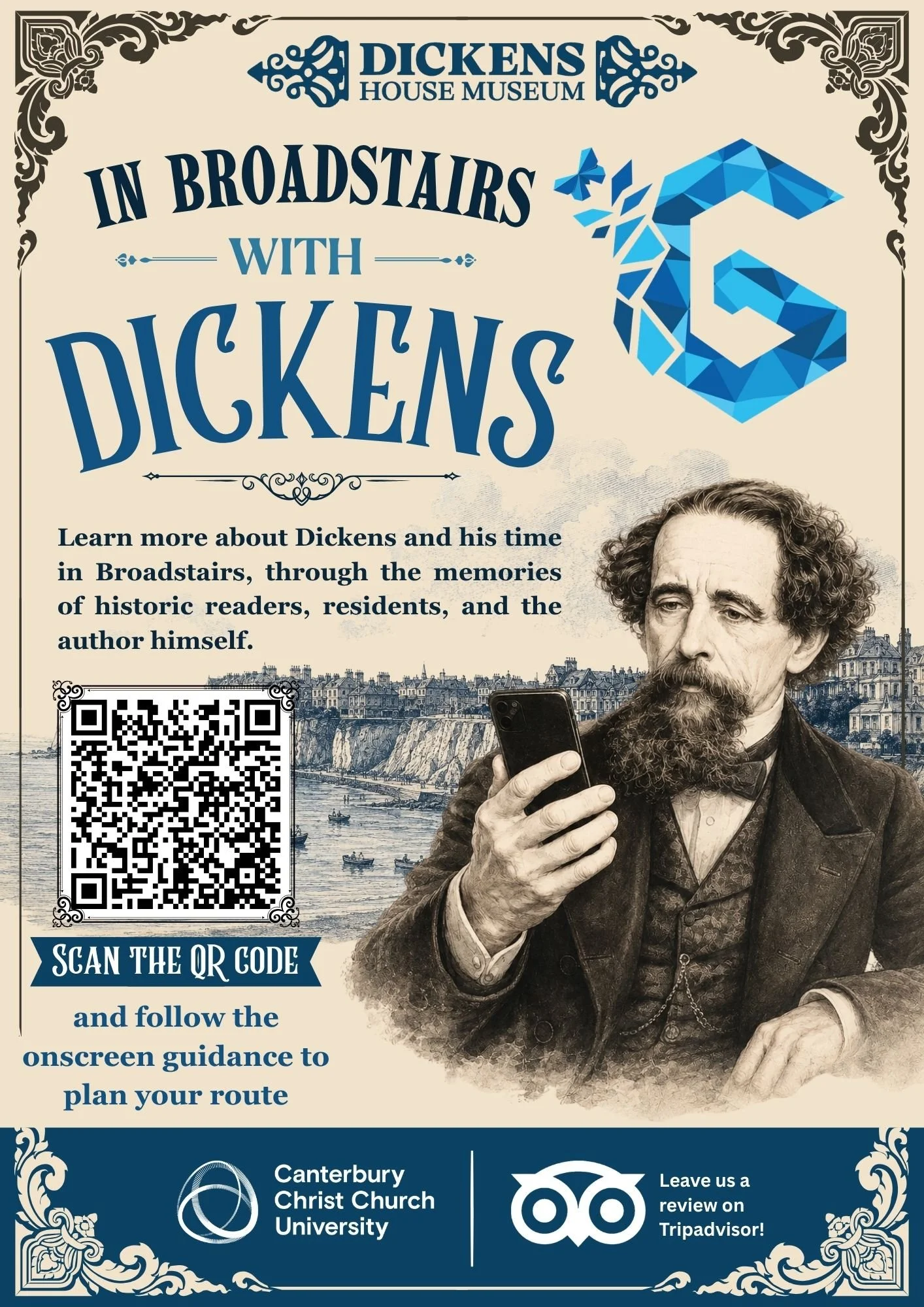
In Broadstairs with Dickens, poster by Heather Murdoch.
This is also the premise of the CCCU volunteering project ‘Let’s do the time walk again! Exploring the East Kent Coast Through Digital Heritage’ (funded by the National Lottery Heritage Fund). Working in partnership with four museums, including the Dickens House Museum, we are researching and digitising archival material to help tell the stories of Kent’s historic seaside towns. Dickens is a key part of this history, but so are the people who continue to visit the places he loved. So we have partnered with Gazooky Studios to create a new audio trail in Broadstairs itself. Visitors can listen to extracts from Dickens’s letters, and hear him speak. But we have also included passages from those early literary tourists, Thomas Frost, William Hughes and Frederick Kitton, alongside the voices of residents and 21st century writers. In Heather Murdoch’s poster you can see Dickens peering at his mobile phone.
Like a visitor on his own tour, he is getting ready to watch us watching him.
Works Cited
Bowen, Elizabeth. Eva Trout. London: Vintage Books, 1999.