
The Good, the Bad, and the Ugly: The Verse of Charles Dickens
This post is contributed by Lydia Craig. Lydia is Assistant Professor of English at Vincennes University and Associate Editor both of The Dickensian and The Charles Dickens Letters Project. The Verse of Charles Dickens can be ordered from Edinburgh University Press as Hardback or eBook (pdf and epub).
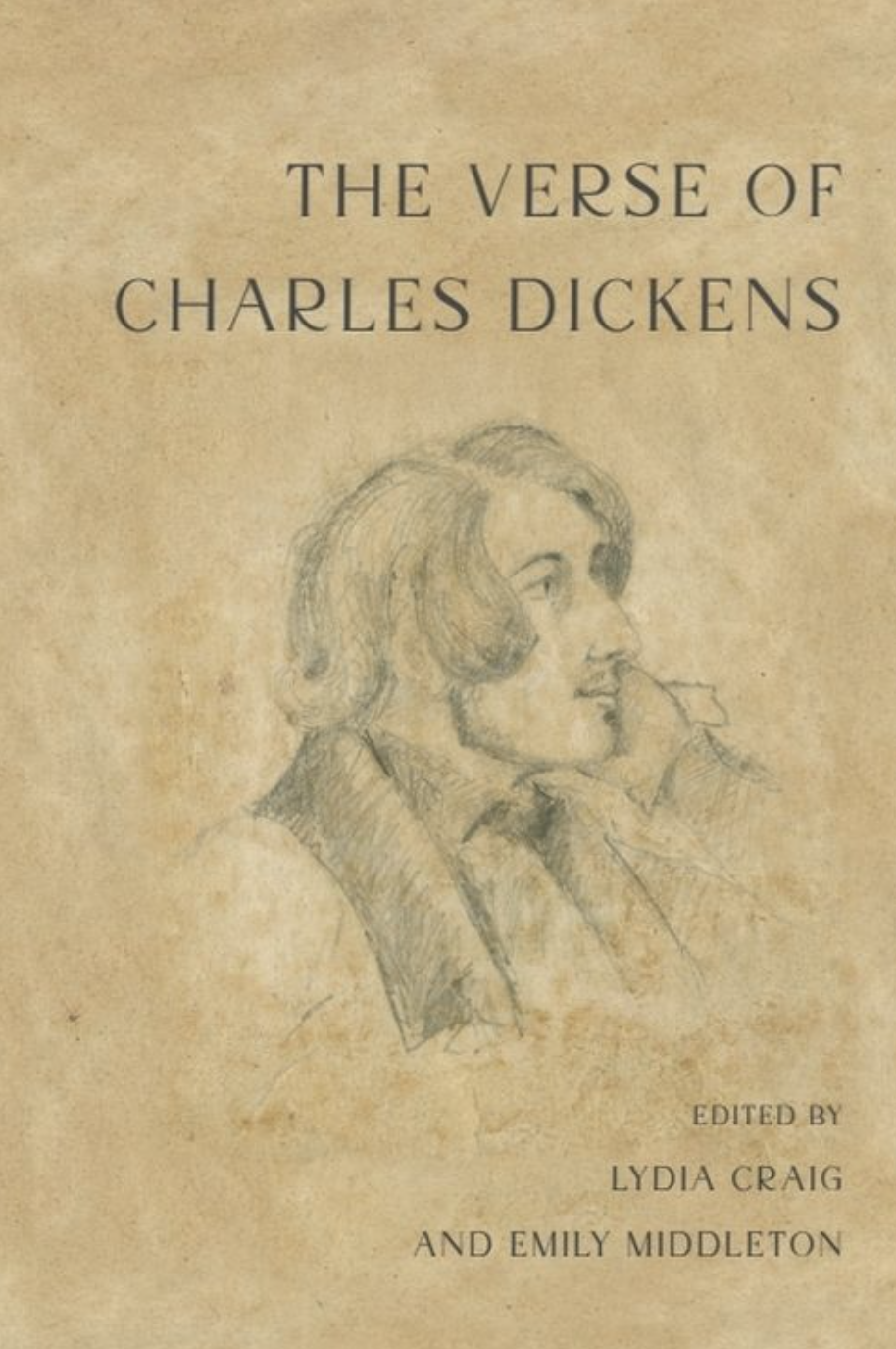
The Verse of Charles Dickens (2025); featuring an 1838 pencil sketch by Priscilla Horton. Free Library of Pennsylvania.
Charles Dickens is better known for his novels and short stories, journalism and plays – literally, almost any other literary genre – than he is for his poetry. One reason for that might be its poor quality: in the role of poet, Dickens often seems to resent and ignore the constraints of poetic metre or rhyming conventions, deliberately chooses odd words for comedic effect, and writes on silly themes. Ironically, “Ode to an Expiring Frog,” perhaps his most famous verse production, succeeds so well because the reader of Pickwick Papers (1836-7), the novel in which it appears, is supposed to recognize the two stanzas quoted as bad poetry:
Can I view thee panting, lying
On thy stomach, without sighing?
Can I unmoved see thee dying
On a log,
Expiring frog?
Say, have fiends in shape of boys,
With wild halloo and brutal noise,
Hunted thee from marshy joys,
With a dog,
Expiring frog? (The Verse 88)
The ode’s author, Mrs. Leo Hunter, can write absurd poems that are still widely celebrated by her circle of acquaintance because she is an elite and influential society hostess. Was Dickens sometimes accorded the same privilege because of the famous novels and other writings he produced rather than because he had any real poetic talent? This is one of the questions considered in The Verse of Charles Dickens (Edinburgh University Press, 2025), a recent edition of Dickens’s verse I have co-edited with Emily Middleton.
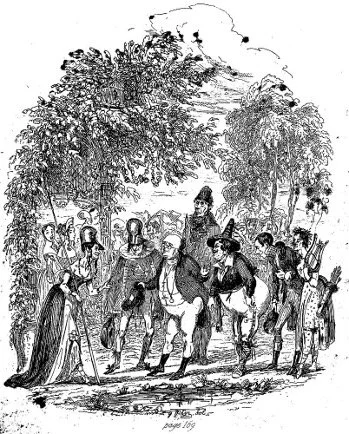
Mrs. Leo Hunter’s Fancy-Dress Déjeûné by Phiz (Hablot K. Browne), September 1836. Scanned images and text by Philip V. Allingham for The Victorian Web.
In the 1800s, verse was recognized as a distinct category of literature with very lofty standards. As the century began, Romantic poet William Wordsworth had included a Preface (1802) in the second edition of Lyrical Ballads (1798), which defined it as a container for conveying deep human truths that must respect meter but not be too strict. Meaning, passion, and purpose were most essential: “For all good poetry is the spontaneous overflow of powerful feelings” (xi). At the height of the Victorian era, there was more critical rigidity. William Allingham’s “On Poetry” (1867) insists that the genre “includes every highest quality of Prose, and includes them in a definitely metrical and musical form, peculiar to itself,” a form that was supposed to “give to words their greatest attainable force and beauty” and convey “the highest thoughts incomparably better than Prose” (524). Nearly all of Dickens’s verse (1830-1870) was written between these two assessments and most of it would not qualify for either Wordsworth or Allingham’s ideal of good poetry, though it can be quite amusing and clever in the tradition of comic verse or parody, as in the case of “Ode to an Expiring Frog.”
Looking to these two poets and critics as cultural touchstones, we don’t know what Wordsworth thought of the quality of Dickens’s verse, specifically. According to one (admittedly dubious) biographer of Dickens, Robert Shelton Mackenzie, it was rumored that after meeting the “great Novelist” once in 1843 the aging poet termed Dickens a “talkative, vulgar young person” and boastfully mentioned that he had “never read a line he has written.” Even less complimentary was Dickens’s reported assessment of Wordsworth as “a dreadful Old Ass” (Mackenzie 243). But Allingham, at least, though a major fan of the novels and occasional writer for Household Words, did not believe Dickens respected poetic form sufficiently. He confided to Leigh Hunt in a letter of 14 June 1852: “No one admires and enjoys Dickens more than I do, but I don’t believe he cares a rush for Poetry in the stricter sense” (Letters 15-16; Quoted in “William”). Perhaps his experiences with Dickens informed Allingham’s 1867 thoughts on good and bad poetry, which he published in Fraser’s Magazine.
While Dickens saved the “overflow” of his “powerful feelings” for prose, the genre in which he truly excelled, as I explain in the introduction to The Verse of Charles Dickens, he used the popular genre and culture of poetry for a variety of personal and utilitarian reasons: to bond with friends using humor and private jokes, flirt, mock Romantic conventions, enliven prose writings, or even to grieve for the recently departed by composing epitaphs for their tombstones or elegies in their memory. This can complicate assessment of whether Dickens is writing a poem in an earnest spirit or for a lark – in fact, whether he means for us to take him seriously at all! It can be frustrating but also rather fun to sit with this ambiguity while reading Dickens’s poetic output.
Consider one instance of this “new” verse by Dickens, meaning manuscripts largely or entirely unknown to scholarship that we have located in archives around the world and included in this edition. One of the songs he wrote for the comic burletta The Village Coquettes (1836) (ultimately discarded by composer John Hullah and not used in performance) is – memorable:
He despises, he shuns me! The thunder-bolt falls
On the rock-seated castle, and crumbles its walls:
The whirlwind destroys with its furious breath,
The lightning is charged with its mission of death;
But the Tempest that scatters my hopes in the air,
More terrible far, bids me live and despair.
He despises, he shuns me! There’s guilt on my name,
It drives me to madness; it brands me with shame. (The Verse 81)
Was this song designed to be so overly-Romantic that the audience would roar with laughter? Or, was Dickens reaching for too many metaphors as a budding playwright struggling to depict the depths of young love’s despair? I incline towards the first view, but it can be difficult to tell.
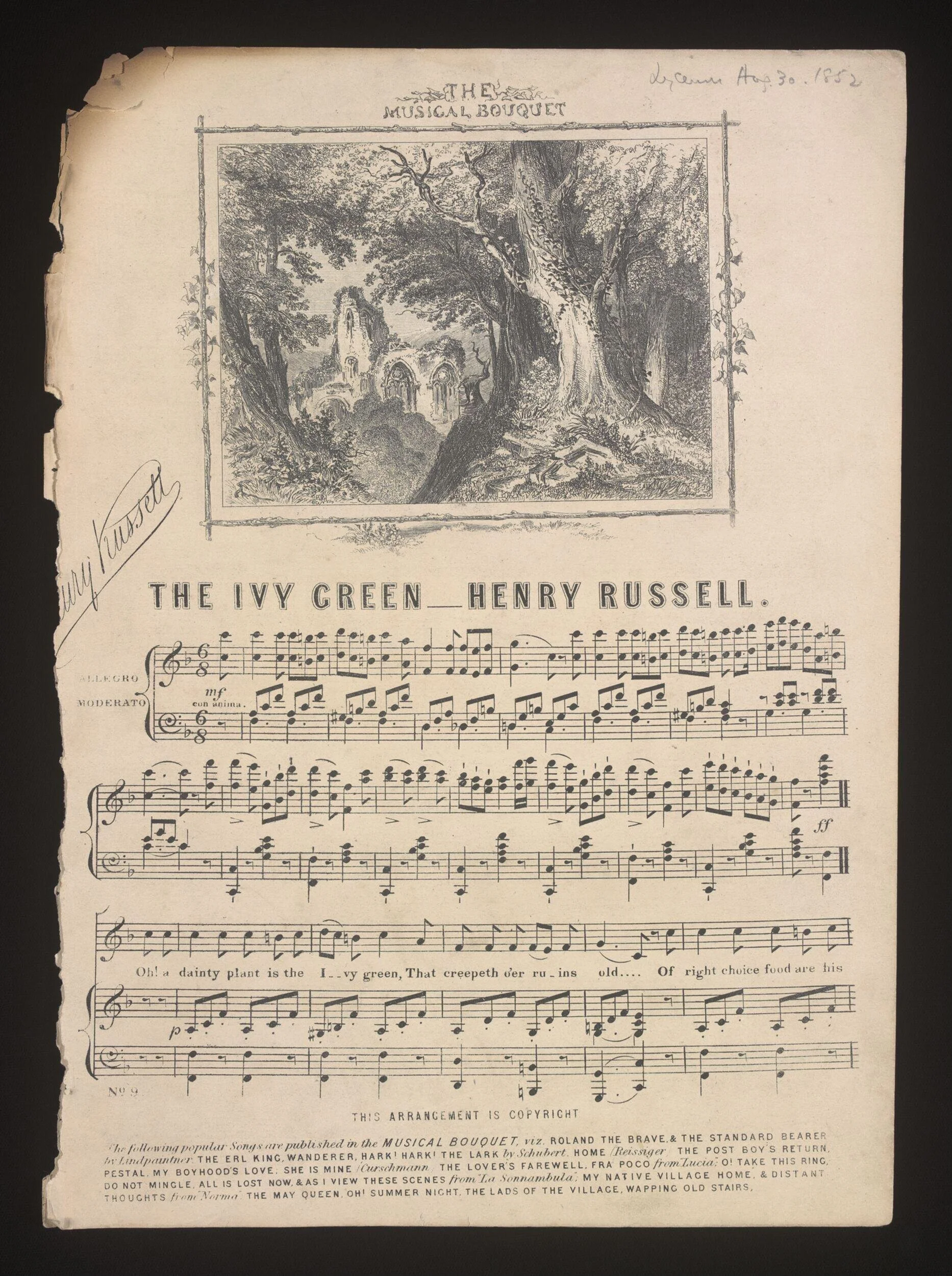
“The Ivy Green.” Lyrics by Charles Dickens, music by Henry Russell. V&A, https://collections.vam.ac.uk/item/O1292257/the-ivy-green-sheet-music-russell-henry/
Undoubtedly, other published poems by Dickens were very successful by the standards of the Victorian era. “The Ivy Green” (1836) was among the poems by Dickens set to music by professional musicians and performed at pianos across the world throughout the century, a song not only beloved for its appearance in Pickwick Papers but also for its lyrics and melody. Like “Ode to an Expiring Frog,” it also received its fair share of good-humored parody in the decades after its publication, a sign of its enduring popularity (The Verse 84-5; 10). While Dickens may not have been a sterling example of nineteenth-century poetic talent, his lifelong interest in the genre can still tell us much about the Victorian culture of verse, not to mention his own interest in and use of the form as writer, editor, and yes, poet.
Works Cited:
Allingham, William. Letters to William Allingham. Edited by Helen Paterson Allingham and E. Baumer Williams. Longmans, Green, and Company, 1911.
—. “On Poetry.” (as W.A.) Fraser’s Magazine, April 1867, vol. 75, pp. 523-536. Google Books, https://www.google.com/books/edition/Fraser_s_Magazine_for_Town_and_Country/rX9GAQAAMAAJ.
Dickens, Charles. The Verse of Charles Dickens. Edited by Lydia Craig and Emily Middleton. Edinburgh University Press, 2025.
Mackenzie, Robert Shelton. The Life of Charles Dickens. T.B. Peterson & Brothers, 1870.
“William Allingham.” Dickens Journals Online, https://www.djo.org.uk/indexes/authors/william-allingham.html.
Wordsworth, William. Lyrical Ballads. T.N. Longman and O. Rees, 1802.