
Prizes and Awards
Bursary Scholarships
Symposium Bursaries
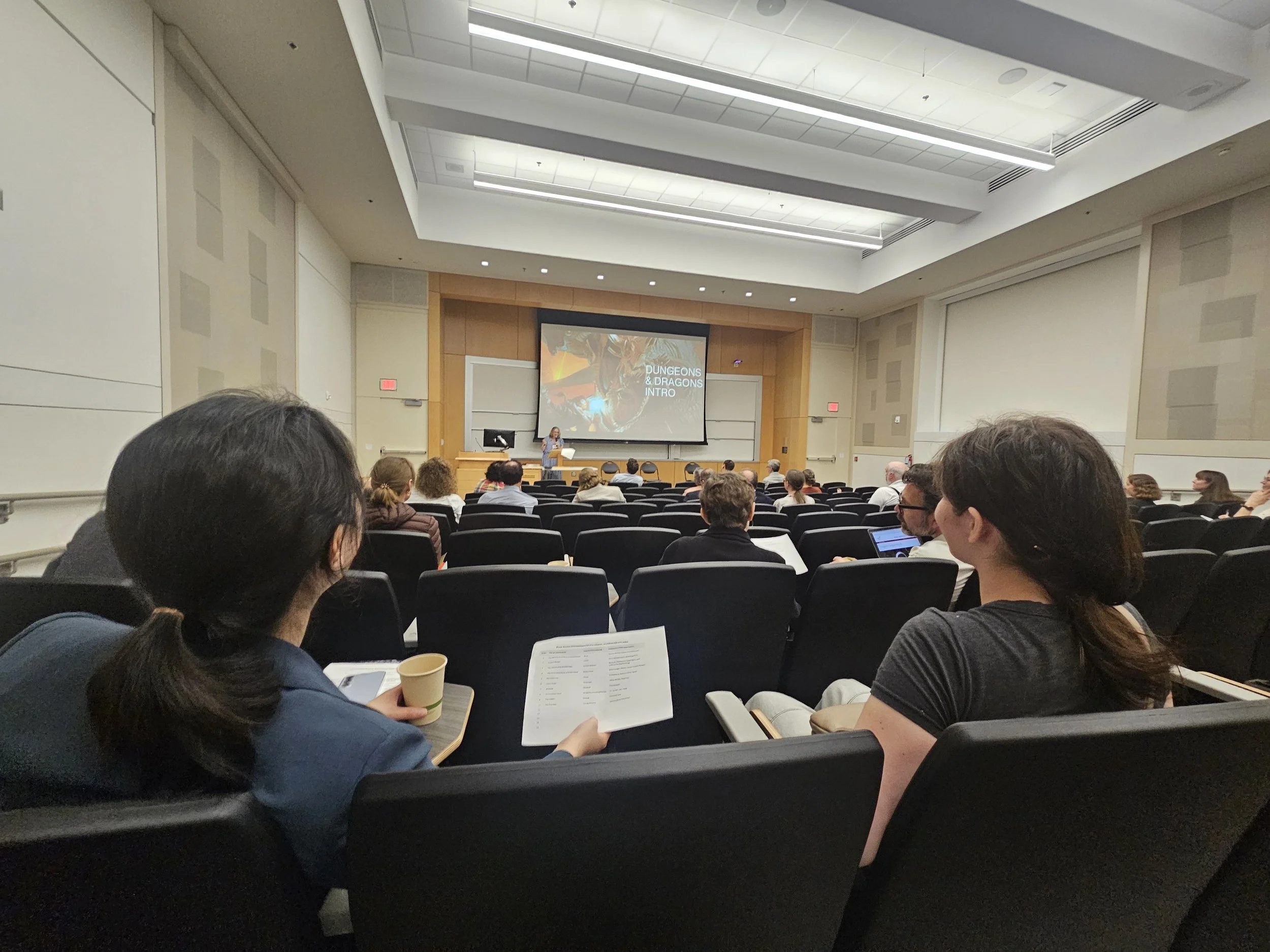
Each year, the Dickens Society offers a number of bursary scholarships to support the cost of symposium travel and attendance by individuals whose presentations have been accepted and who lack institutional support.
Eligibility is restricted to graduate students, non-tenure track faculty, and independent scholars.
To apply, submit 1) a CV and 2) a cover letter a) outlining travel costs, specifying financial requirements and disclosing any institutional support already granted, and b) outlining how the applicant plans to use their skillset to contribute to the Dickens Society’s social media activities during and/or following the Symposium.
In previous years, successful applicants often agree to collaborate on a symposium report (published on the Society’s blog), write another blog post relating to their presentation topic or another theme, post on the Society’s accounts such as Bluesky and Facebook during the symposium, or pursue another short-term initiative (YouTube, Discord, etc.).
Awards will be dispensed at the Dickens Society Symposium by Leslie Simon, the Society Treasurer, via PayPal or Venmo.
For the 2026 contest, submissions should be sent to Ben Moore, the Society Secretary, at dickenssocietysecretary@gmail.com by 31 May 2027.
The Cricket: Best Blog Bursary
A new bursary has been adopted by the Dickens Society to cover the costs of attending the annual Symposium for the author of the best blog publication on the Society’s website during the academic year.
Criteria such as clarity, originality, engagement with current scholarly conversations, and accessibility to a broad audience may be considered, though the final selection will rest on the editors’ holistic judgment.
The bursary will waive the fee of the Symposium, and the winner would need to become a member of the Society if they were not one already.
Blog posts should be 800-1000 words long and should be written for a mainstream audience. They should follow the same formatting rules as Dickens Quarterly. The use of (public domain or free use) images is appreciated.
Award will be dispensed by Leslie Simon, the Society Treasurer, via PayPal or Venmo.
For the 2027 contest, submissions or questions should be sent to Dr. Céleste Callen (drcelestecallen@gmail.com) by 31 May 2027.
The Robert B. Partlow, Jr. Prize
The Robert B. Partlow, Jr. Prize is named in honor of Robert Partlow (1919-1997), the original Secretary-Treasurer and one of the founding members of The Dickens Society. Bob Partlow taught at Boston University, the University of New Hampshire and Southern Illinois University, where he chaired the English Department from 1957 until he retired in 1979.
Bob was also responsible for founding Dickens Studies Annual, a hard-bound collection of scholarly essays, published by Southern Illinois University Press, which he edited from 1971 to 1978. Thereafter the journal moved in 1980 to New York City, where it has been published by AMS Press in cooperation with Queens College and The Graduate Center of The City University of New York and continues as Dickens Studies Annual: Essays on Victorian Fiction.
Applications are invited for this award. It may be in the form of EITHER one stipend of $500 OR two of $300 (if two recipients are chosen), and is intended to defray costs of attending the Dickens Symposium, in order to deliver a paper on any aspect of Dickens’s life or work. The registration fee and cost of the Dickens Dinner will also be waived. Eligibility is restricted to graduate students, independent scholars, and non-tenured faculty who have been accepted to the upcoming symposium. Award will be dispensed at the Dickens Society Symposium by Leslie Simon, the Society Treasurer, via PayPal or Venmo.
For the 2027 contest, candidates should submit a CV and a completed paper of 20-minutes duration, to Symposium Organizer by 15 April 2027. Should the paper be of publishable quality, the Dickens Quarterly shall have first right of refusal.
Recent Recipients:
2026: Liu Li (Independent Scholar): “Composing His Writing Out Loud: Thinking the Narrator as Public Reader with Hard Times.”
2025: Jessica Campbell (Independent Scholar), ‘”What can you two be together?’: Clean and Dirty Female Relationships in Little Dorrit“
2024: Dean J. Hill (University of Birmingham), “Bridging Epochs: Exploring the Confluence of Dickensian Creativity and Artificial Intelligence in a Techno-Literary Landscape”
Honorable Mention: Christian Lehmann (Bard High School Early College), “Emily’s Dickens: Engagement and Reuse”
2023: Anya Eastman (Royal Holloway, University of London), “Mediated Perceptions, Refractions and Reflections: Reading the Dickens Museum as Pepper’s Ghost”
2022: Eleonora Gallitelli (Independent Researcher), “‘If the true story of the matter is to be told’: Dickens and the Neapolitan prisoner”
2021: Sophia Jochem (Freie Universität Berlin, “Fungi and the City: Dickens’s Urban Aesthetic of Decay”
2020: Matthew Redmond (Stanford University), “Beyond the Attic: Dickens and Little Women“
The David Paroissien Prize
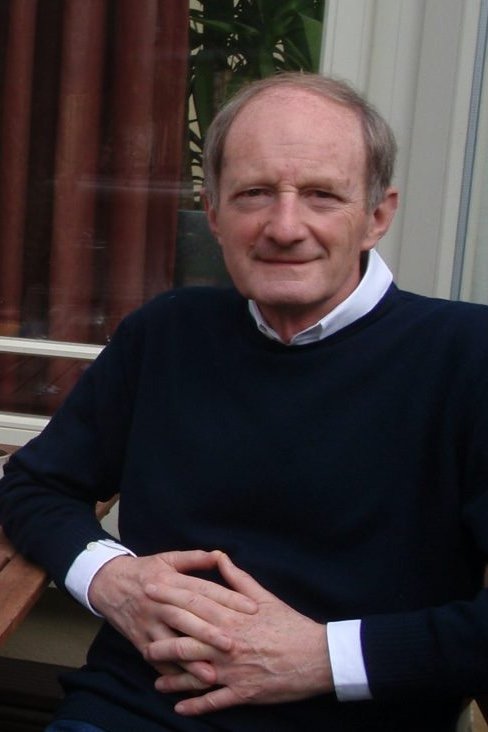
The David Paroissien Prize is awarded each year to the best peer-reviewed essay on Dickens published in a journal or edited collection. The Prize is named for David Paroissien (1939-2021), a founding member of the Dickens Society and also the founder of Dickens Quarterly, which he edited from its first issue in 1983 until his final issue in December 2020. As an editor he was rigorous, tactful, and generous, particularly with younger scholars. Under his direction, Dickens Quarterly attracted contributions from Dickens scholars around the world and became a leading venue for new work in the field.
To nominate (or self-nominate) an essay for the Paroissien Prize, please provide a copy of the essay and a cover email giving the name, email address, and institutional affiliation (if any) of its author. For the 2026 competition (essays published 1 January 2026 – 31 December 2026), send these materials to the Society Secretary at dickenssocietysecretary@gmail.com by 31 January 2027. A three-person committee comprised of Officers and/or Trustees will judge submissions. Please note that, in determining an essay’s eligibility for a given year, the actual date of appearance is what matters, not the nominal date of the journal issue, since it is common for journals to lag behind their publication date. Any author may be nominated for this Prize, whether or not they are a Society member.
The Prize carries a cash award of $500 and waives the registration fee for the Symposium at which the recipient will be recognized. Awards will be dispensed at the Dickens Society Symposium by Leslie Simon, the Society Treasurer, via PayPal or Venmo.
Recent Recipients:
2026: Sara Malton (Saint Mary’s University), “Apparition, Time, and the Movement of The Chimes.” Margins/Marges/Margini, no. 2, January 2025, pp. 76–95, doi: 10.7413/2974-9549019 AND Meoghan Cronin (Saint Anselm College), “‘Seeing our Sister-Women Suffer’: Responding to Assaults against Women in Barnaby Rudge and David Copperfield.” Dickens Quarterly, vol. 42 no. 3, 2025, pp. 247-268. Project MUSE, doi: 10.1353/dqt.2025.a969752.
2025: Katherine J. Kim, “Writing to Control the Narrative: Charles Dickens, PTSD, and the Staplehurst Rail Crash.” Dickens Quarterly, vol. 41, number 2, June 2024, pp. 249-70, doi: 10.1353/dqt.2024.a929047.
Honorable Mention: Heidi L. Pennington, “Biography in Bits and Pieces: Selling Ethel Dickens in the Periodical Press.” Ch. 6 In Life Writing and the Nineteenth-Century Literary Market. Edited by Sean Grass. Edinburgh University Press, 2024, pp. 161-188, https://edinburghuniversitypress.com/book-life-writing-and-the-nineteenth-century-literary-market.html.
2024: Sharon Aronofsky Weltmann (Texas Christian University), “The Littleness of Little Dorrit.” The Review of English Studies, vol. 74, issue 316, October 2023, pp. 697-713, doi: 10.1093/res/hgad061.
2023: Eva Dima (University of Cambridge), “‘Wind, Wind, Wind, Always Winding Am I’: Dickens’s Metafictional Clockwork.” The Review of English Studies, vol. 73, issue 310, June 2022, pp. 552-567, doi: 10.1093/res/hgab094.
Honorable Mention: Lydia Craig (Lake Land College), “‘Keep[ing] the Outward Figure Away from the Fact’: Reading Harold Skimpole as a Person of Color in Bleak House.” Dickens Quarterly, vol. 39 no. 3, 2022, p. 312-337, doi: 10.1353/dqt.2022.0026.
The Mary Espartero Webb Travel Award
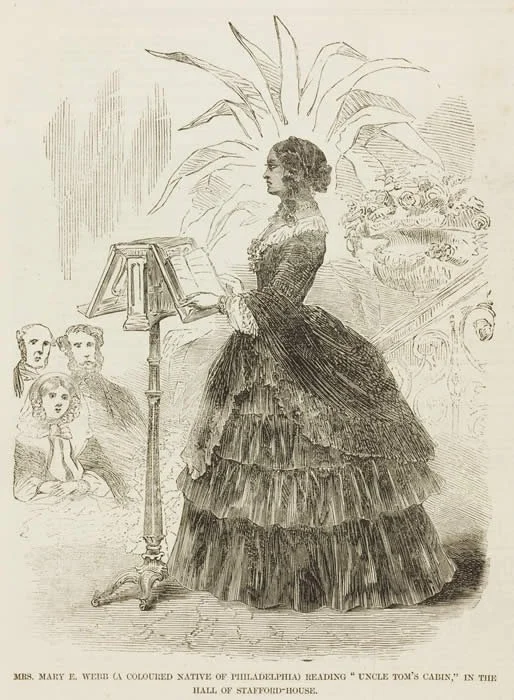
The Mary Espartero Webb Travel Award honors Mary Espartero Webb, a Black American thespian based in Philadelphia, PA whom Charles Dickens declined to meet or assist during her 1857 tour of Great Britain. In the United States of America, Webb was renowned for her spellbinding performances adapted from such literary material as Harriet Beecher Stowe’s influential novel Uncle Tom’s Cabin (1852) and the poems of Henry Wadsworth Longfellow. Dickens’s 15 April letter to the Earl of Carlisle not only refuses Webb a performance venue and his social patronage in England, but also objects to her recitation of William Shakespeare’s drama in a popular series of public readings.[1] By establishing the Mary Espartero Webb Travel Award, the Dickens Society acknowledges the long history of exclusion and barriers– including those maintained by Dickens himself – faced by BIPOC scholars in academia and literary studies and with this award seeks to create space, promote equity and diversity, and support their scholarship.
This award is given to a member of the Dickens Society identifying as Black, Indigenous, or another underrepresented person of color whose conference paper, deliverable in 15-20 minutes and presented at the Dickens Society Symposium on a topic in Dickens studies, demonstrates originality and rigor.
To apply for the Webb Prize, please provide a copy of the essay and a cover email giving the name, email address, and institutional affiliation (if any) of its author. For the 2026 competition, send these materials to the Society Secretary at dickenssocietysecretary@gmail.com by 1 May 2027.
The winner will receive a financial prize via PayPal or Venmo to defray travel expenses, awarded at the Dickens Dinner by Leslie Simon, the Society Treasurer, and their symposium registration fee will be waived.
Dickens Quarterly will have first right of refusal should the paper be revised and expanded into a full-length article.
[1] See Korobkin, Laura. “‘Avoiding “Aunt Tomasina’: Charles Dickens Responds to Harriet Beecher Stowe’s Black American Reader, Mary Webb.” ELH, vol. 82, no. 1, 2015, pp. 115-140, https://dx.doi.org/10.1353/elh.2015.0007