
Book Review: The Scent of Oranges by Kathy George

This post is contributed by Melisa Kaya, a graduate with honors in English and Creative Writing from Saint Mary’s University, Canada. As a writer, editor, and researcher, her primary research examines the intersection of literature and science, exploring their mutual influence. Additionally, Melisa engages in various other research projects, including investigations into Victorian movie adaptations and historical perspectives in world literature. Melisa is also a member of the Dickens Society Communications Team.
Kathy George’s The Scent of Oranges (2024) returns to Oliver Twist (1837–39) through one of Charles Dickens’s most morally charged figures: Nancy. The novel does not merely ask what might have happened “offstage” in Dickens’s plot, nor does it simply give Nancy more scenes. Its more ambitious project is to let Nancy become reader, interpreter, and witness of the world that consumes her. George follows much of the familiar architecture of Oliver Twist, including Fagin’s rooms, London Bridge, Folly Ditch, and Newgate, and characters such as the Artful Dodger, Bill Sikes, Monks, Rose Maylie, and Mr. Brownlow, but redirects the novel’s emotional and moral pressure through Nancy’s own voice.
The opening is immediately revealing. Nancy sees Oliver before she knows is formally introduced to him, and he appears to her not as a plot device but as an almost sacred disturbance: angelic, vulnerable, and strangely connected to her own fate. “Instinct tells me we are connected,” she says, and the line becomes one of the novel’s governing principles (George 8). Oliver is not only the innocent child of Dickens’s novel; he is also the figure through whom George’s Nancy begins to recognize her own abandonment, her hunger for tenderness, and the narrowness of the life she has been compelled to inhabit.
The great risk of the book is its first-person narration. Nancy speaks in a sustained dialect that might easily have become oppressive or theatrical. At its best, however, it is supple, funny, sharp, and deeply revealing. George’s Nancy is not educated in the conventional sense, but she is brilliantly literate in danger. She reads rooms, faces, tones, gestures, clothing, smells, and silences. Her illiteracy matters, and she is painfully self-aware of it, but the novel never permits literacy to stand as the sole measure of intelligence. On the contrary, it repeatedly shows that Nancy’s survival depends upon her interpretive skills, as well as on her persistent desire to learn when given the opportunity.
George’s most substantial addition to Dickens’s world is Rufus, a gentleman who first enters the narrative as a client and then becomes a source of tenderness, fantasy, risk, and moral complication. Their first encounter, involving abandoned fox cubs, beautifully establishes the novel’s concern with vulnerable creatures born in the wrong place at the wrong time. Yet Rufus is not simply a rescuer. He later hires Nancy, asks her to impersonate a mute gentlewoman and present herself as his fiancée to Aunt Maud, whose financial support he depends upon, and he is drawn to her partly because she resembles his dead mother: “You are remarkably like her. Only in looks, of course. In personality and nature, you are quite different” (George 43). This admission gives the relationship an uneasy psychological charge. Rufus’s feelings for Nancy are real, but they are neither pure nor free of exchange; rather, they are entangled with grief, class anxiety, desire, and need.
The “Miss Titania Richardson” episodes with Aunt Maud, (in which Nancy pretends pretends to be a lady), are among the novel’s liveliest and most revealing. Nancy’s performance of gentility is comic, precarious, and socially astute: the dress, the pinching shoes, the silence, the inability to write fluently, the rules of tea, cards, posture, and conversation all become tests of class legibility. Aunt Maud, who first appears merely formidable, becomes one of the novel’s more interesting figures because she sees more than Rufus imagines. Her eventual unmasking of Nancy is not simply a plot turn; it exposes the fragility of the whole fantasy of transformation. Nancy may dress as Titania, but she cannot safely become her.
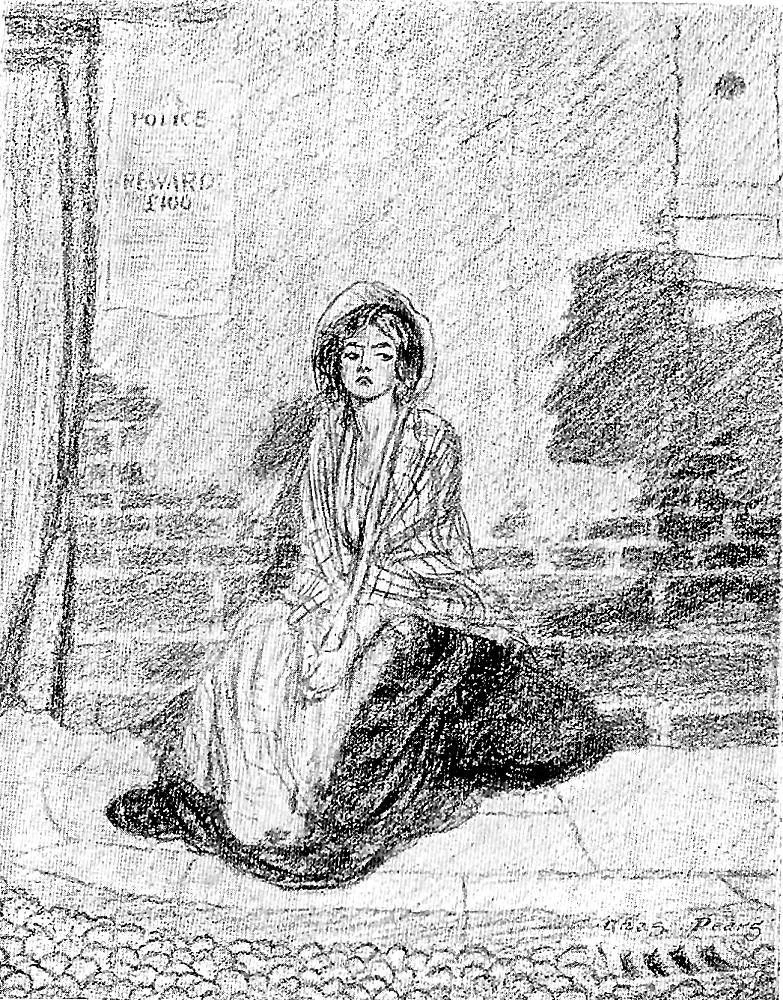
Charles Pears, “Nancy,” 1912. Scanned image and text for The Victorian Web by Philip V. Allingham.
The orange motif is especially well handled. Oranges are not merely decorative symbols of brightness in a soot-darkened London. They are associated with memory, appetite, instruction, and unpurchased kindness. Nancy’s recollection of the man who once taught her how to eat an orange gives the title its emotional depth: he was “the only one that shared knowledge with me, and never wanted anything in return” (George 87). In a novel filled with exchange, debt, coercion, and bodily exploitation, the orange becomes the sign of a different economy altogether: sweetness without demand, a generosity Nancy also selflessly tries to extend to Oliver.
As a Dickensian reimagining, The Scent of Oranges works best when it neither imitates Dickens slavishly nor rejects him defensively. George understands the emotional force of Dickensian melodrama: coincidence, disguise, hidden kinship, threatened children, overheard secrets, theatrical reversals, and prison-cell revelation. She also understands that Nancy’s tragedy in Oliver Twist lies not only in her murder but in the narrowness of the alternatives available to her. George extends that tragedy by giving Nancy glimpses of alternative forms of attachment and belonging: Rufus’s imagined marriage, Oliver’s possible rescue, the Dodger’s belatedly discovered brotherhood, and Aunt Maud’s imperfect sympathy.
The novel is also alert to the moral difficulty of Nancy’s loyalties. Bill Sikes is violent, possessive, and terrifying; George never excuses him. Yet she does show why Nancy’s attachment to him cannot be reduced to foolishness. He is dangerous, but he is also damaged, dependent, and intermittently pitiable. Fagin, too, is treated with more emotional complexity than simple villainy would allow. He is manipulative, exploitative, and self-protective, but also bound to Nancy by a long, corrupted intimacy. The late revelation that the Artful Dodger is Nancy’s brother is melodramatic, even audacious, but it is not arbitrary. It gathers together the novel’s recurring concern with lost children, broken families, and kinship recognized too late. When Fagin finally says of the Dodger, “That he’s her brother,” the shock retrospectively clarifies Nancy’s long affection for him (George 193).
The final chapters make the novel’s counterfactual imagination clearest. After Nancy’s murder, George allows her to remain as a spirit, witnessing Sikes’s terror, the failed wedding with Rufus, Sikes’s death, Oliver’s future security, and Fagin’s last hours in Newgate. The choice does not save Nancy from her canonical fate. Instead, it gives her the power to see what her sacrifice sets in motion. That distinction matters: Nancy’s afterlife does not undo the brutality of her death, but it refuses to let that death be the end of her consciousness.
The wedding scene at St Magnus the Martyr is particularly effective. Rufus waits, Aunt Maud understands more than she says, and a bowl of oranges stands where flowers might have been. Nancy, already dead, sees the life she might have entered and also recognizes why it could not easily have lasted. “So many ways to live a life,” she thinks, in one of the book’s simplest and most resonant lines (George 185). The sentence captures the novel’s counterfactual ache: not a denial of Dickens’s plot, but a sustained mourning for the various lives Nancy might have lived under different conditions.
The novel’s later movement is expansive in the best Dickensian sense. The Rufus-Aunt Maud inheritance plot, Monks’s conspiracy, Bill’s decline, Nancy’s spiritual witness, and Oliver’s eventual restoration all gather into a conclusion rich in coincidence, revelation, pathos, and moral reckoning. Rather than seeking modern minimalism, George allows the narrative the emotional amplitude of nineteenth-century fiction. The result is a novel that understands melodrama not as excess, but as a serious moral language: a way of staging vulnerability, desire, justice, and grief on a scale large enough to honor Nancy’s imaginative and emotional life.
For readers of Dickens, The Scent of Oranges is a thoughtful, serious-minded, and emotionally generous companion to Oliver Twist. Its finest achievement is not simply that it gives Nancy a fuller biography, but that it gives her a sustained intelligence: sensuous, wounded, humorous, self-divided, and morally alert. The final return to her name, “Starting off low and ending up high. Finishing bright and cheerful-like. In the clouds. That’s me. Nancy,” is a fitting close to a novel that begins in the murk of Saffron Hill and keeps searching, through smoke, hunger, violence, grief, and longing, for some lingering scent of sweetness (George 194).
Works Cited:
George, Kathy. The Scent of Oranges, e-book ed., HQ Fiction, 2024. Apple Books.