
In Memory of Jerome Meckier
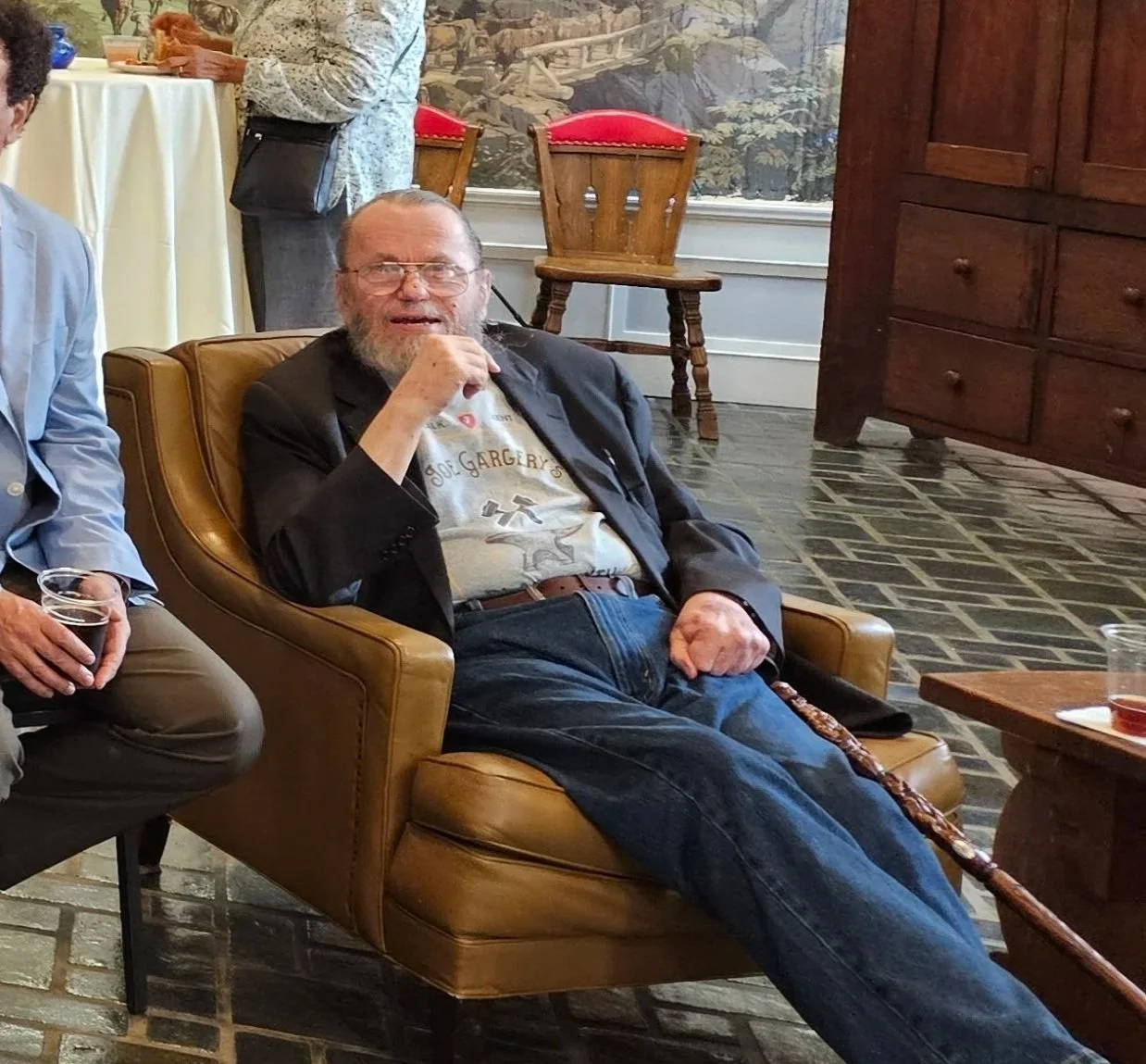
Jerome Meckier at the 2023 Dickens Society Symposium in Rochester, NY.
This post is contributed by Andre DeCuir, Associate Professor of English, Muskingum University, Ohio.
Jerome Meckier peacefully passed away on the morning of April 21, 2025. He is survived by his daughter Alison and grandsons Jacob Gafranek and Coleman Parrish. He was an accomplished scholar, publishing seven books and numerous essays on nineteenth- and twentieth-century English literature. He also co-edited the Aldous Huxley Annual up until his death. In addition, he served as a trustee of the Dickens Society and also as Vice-President and President. He taught for over 30 years, advising and guiding many students in graduate work, and I was one of the fortunate students to have him as my PhD advisor.
First, I would like to address some of his scholarship, as it was important in forming my own professional path. Three works can be seen as a trilogy in Dickens studies, all positing unique ideas supported by close readings of novels, letters, and other documents. Innocent Abroad: Charles Dickens’s American Engagements (1990) shows that Dickens broke away from other writers who characterized America as some kind of Utopia; he found the people loud and crude, and his two visits may have been responsible for the darker vision in his later novels. In Hidden Rivalries in Victorian Fiction: Dickens, Realism, & Revaluation (1996), he argues that some of Dickens’s contemporaries, Wilkie Collins, Elizabeth Gaskell, and George Eliot, for example, “rewrote” Dickens’s works in their own novels, and that Dickens, in turn, “responded” by rewriting theirs. Dickens’s Great Expectations: Misnar’s Pavilion versus Cinderella (2002) serves as a continuation of Hidden Rivalries as he argues that Great Expectations rewrites novels of others who utilize the Cinderella trope. He puts forth that Dickens’s “rags to riches” story, Great Expectations, is more realistic as Dickens based it, not on the ubiquitous fairy tale, but on “Misnar’s Pavilion,” from Tales of the Genii, a tale actually alluded to in Great Expectations.
As one of Jerry’s graduate students, I was asked to examine proofs of Hidden Rivalries, the work that fueled my interest in Dickens. My dissertation was not on Dickens but on Thomas Hardy; still, Jerry was eager to be my advisor. The graduate course I had with him was on the early twentieth-century British novel—still no Dickens—and my research paper for the class was on H. G. Wells (yet another one of Jerry’s passions). I wanted to “impress” him, and my paper got out of hand length-wise. I apologized for the tome I submitted, and he responded with a story about braving a New England snowstorm to deliver a 60+ page paper on George Eliot to a professor. The grin that followed, maybe his way of commenting on my work and work ethic, made me want to do more reading and research with him. I asked if I could do a directed study with him on the Victorian novel. He agreed and asked me to come up with a list of novels I would like to read. To my surprise, and maybe to his, the list consisted mainly of novels covered in Hidden Rivalries! Thus, my interest in Dickens continued.
After floating from adjunct position to adjunct position—the typical life of a new recipient of a PhD in English—I landed a full-time position and was reading to enter the world of Dickens scholarship. I thought submitting to the Dickens Symposium (Montreal was the first one for me) would be a good place to start, and this is when I started to reconnect with Jerry. He always attended the sessions in which I was a panelist, and he was always complimentary in an understated way, capped by a smile and then, later, a drink in the hotel bar.
The last time I saw and talked to Jerry was at the Rochester Symposium in 2023. A group of participants, including Jerry, was sitting outside of a conference room waiting for the next session to begin, and a young scholar asked him what his favorite Dickens novel was. I answered, “I think it’s…Great Expectations.” Jerry smiled wistfully and answered in his typical fashion, like with the George Eliot paper story, in a statement or anecdote from which the listener can extract meaning: “Well, I believe it’s probably the one I’ve written the most about.” So true!
On behalf of the members of the Dickens Society, I would like to thank Jerry for his support and his scholarship, and on a personal note, I would like to thank him for an unconventional introduction to the world of Dickens.
