
From Hull to Boston: My Journey to the Dickens Symposium
Emma Linford, PhD, is an Honorary Research Associate at the University of Hull. She completed her doctorate in 2024 and is currently working on papers about Charles Dickens and Agatha Christie. Find her on Instagram at @emmalinford.
As academics and Dickens enthusiasts gathered in Boston, Massachusetts, for the 30th Annual Dickens Society Symposium, the event reaffirmed Charles Dickens’s remarkable ability to encapsulate the complexities and contradictions of Victorian life. This year’s symposium, titled “Dirty Dickens”, offered a dynamic program that foregrounded the grittier dimensions of his writing: social decay, moral ambiguity, and the material conditions of 19th-century existence. I have chosen to pick some key moments that really stood out to me during my trip. In particular, the Dickens Dinner was such an amazing experience! The food, the company, and the exchange of knowledge at my table were just brilliant. Six people from all over the world, from different backgrounds, all in one place to celebrate Dickens – this was such a memorable experience. I have also picked out one of my favourite presentations, which was by Ian Annetts. He really took a fresh viewpoint on urban squalor and decay in Dickens’s work. After sitting together for the Dickens dinner and meeting for the very first time, I found his work illuminating and really thought-provoking. So much so, I needed to express my admiration of his work.
Held from 15th to 17th July 2025, the symposium took place at Boston University, which served as a fitting location given Dickens’s deep historical ties to Boston. The city played a significant role in Dickens’s American journeys in both 1842 and 1867–68, when he was warmly received by local audiences, especially during his public readings of A Christmas Carol. Notably, Dickens stayed at the Omni Parker House during his second American tour (November 19, 1867, to early April 1868), now a site of literary pilgrimage and the setting for this year’s Dickens Dinner. Charles Dickens’s connection to the Omni Parker House is clear in reports of his own words as shared in a blog post by Gerald Dickens (his great-great-grandson): “This is an immense hotel, with all manner of white marble public passages and public rooms. I live in a corner high up, and have a hot and cold bath in my bed-room (communicating with the sitting-room), and comforts not in existence when I was here before. The cost of living is enormous, but happily we can afford it” (G. Dickens, 2021).
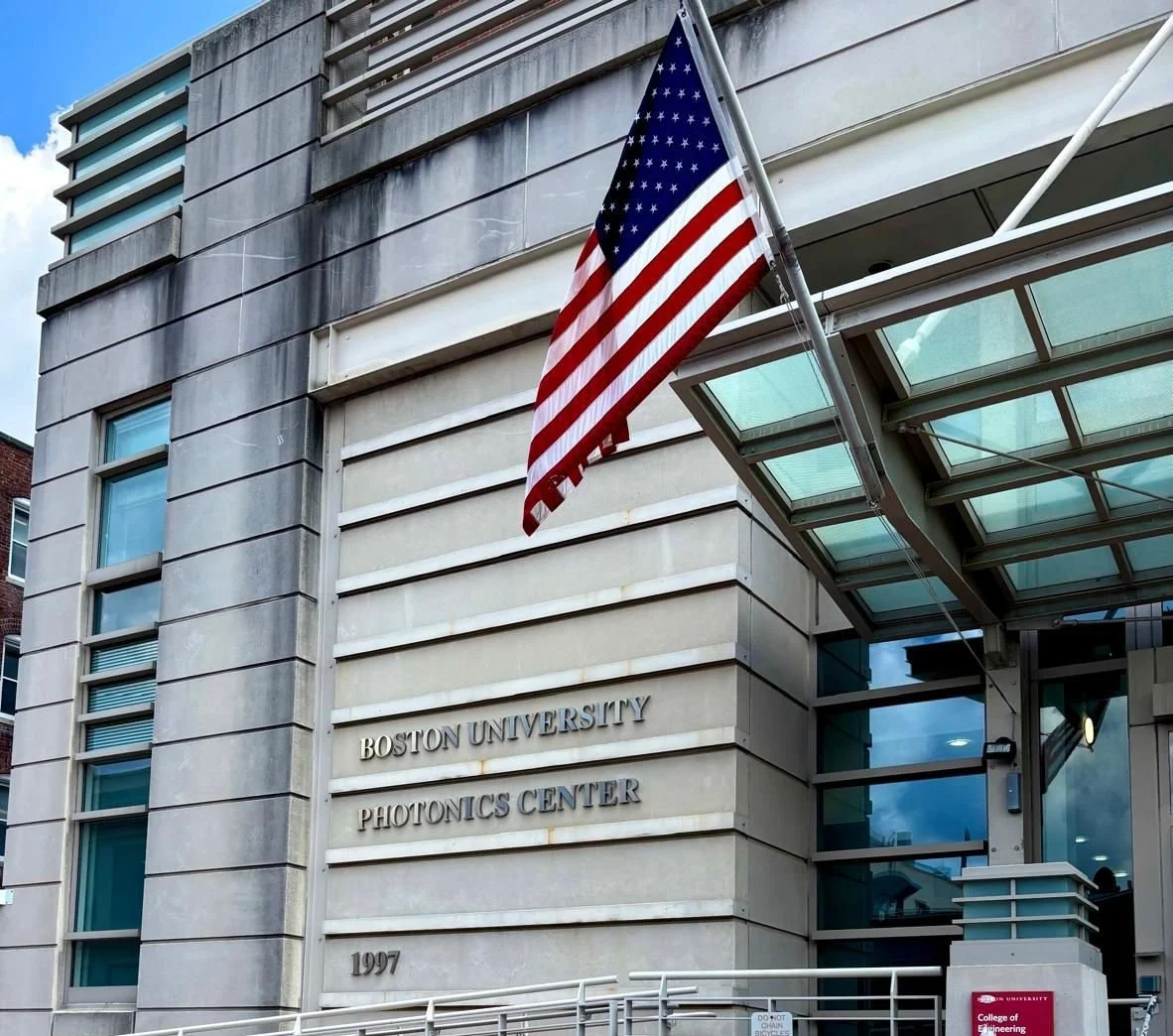
Boston University Photonics Center, which served as the venue for this year’s Symposium (photo by the author).
Throughout the three-day event, participants engaged with a broad spectrum of themes related to Dickens’s life, fiction, and cultural impact. The panels reflected the diversity of contemporary Dickens studies, delving into historical, literary, and socio-political contexts that continue to shape readings of his work today.
The Dickens Dinner
On the evening of Tuesday, 15 July, scholars gathered at the historic Omni Parker Hotel to share conversation, celebrate Dickens’s legacy, and exchange scholarly insights in a more informal setting. The atmosphere was lively and collegial—an evening of spirited discussion, laughter, and camaraderie, all in honour of one of the most enduring literary figures of the nineteenth century.
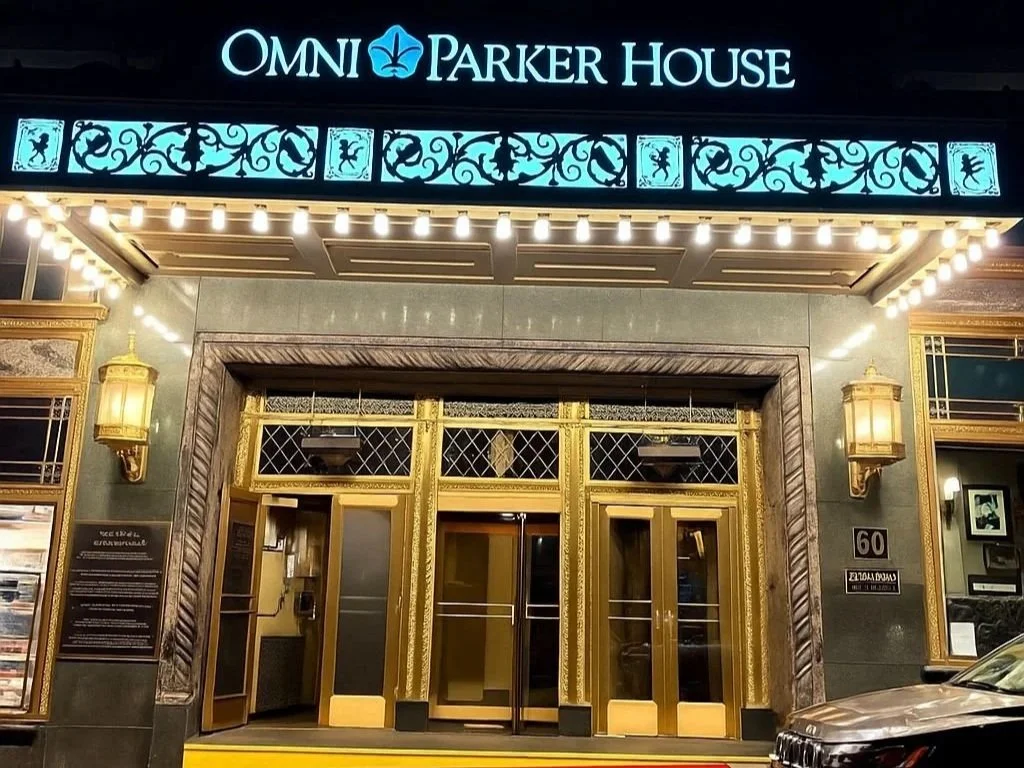
More than just the home of the Boston Cream Pie, the Omni Parker House provided the perfect backdrop for the Dickens Dinner, which even included newly redone carpeting in the dining room featuring the Inimitable’s handwriting (photograph by the author).
The reception at Boston University’s Castle was a warm and memorable occasion, bringing together colleagues in a setting that perfectly complemented the spirit of the symposium.
The Dickens Dinner was a great way to encapsulate the literary analysis and exploration that was going to follow in the following days’ symposium.
Ian Annetts, “Our Mutual Error: How Dickens Chose to Portray 1860s London”
In his paper, Ian Annetts offers a compelling re-evaluation of Our Mutual Friend, challenging the long-standing critical view that the novel is primarily a dark portrayal of urban squalor and moral decay. While it’s true that Dickens draws heavily on images of the polluted Thames and the looming waste mounds encircling mid-Victorian London, Ian argues that these symbols have been too readily interpreted as evidence of cynicism and despair. Instead, he proposes that Dickens’s final completed novel is far more forward-looking and reformist in tone than many have acknowledged.
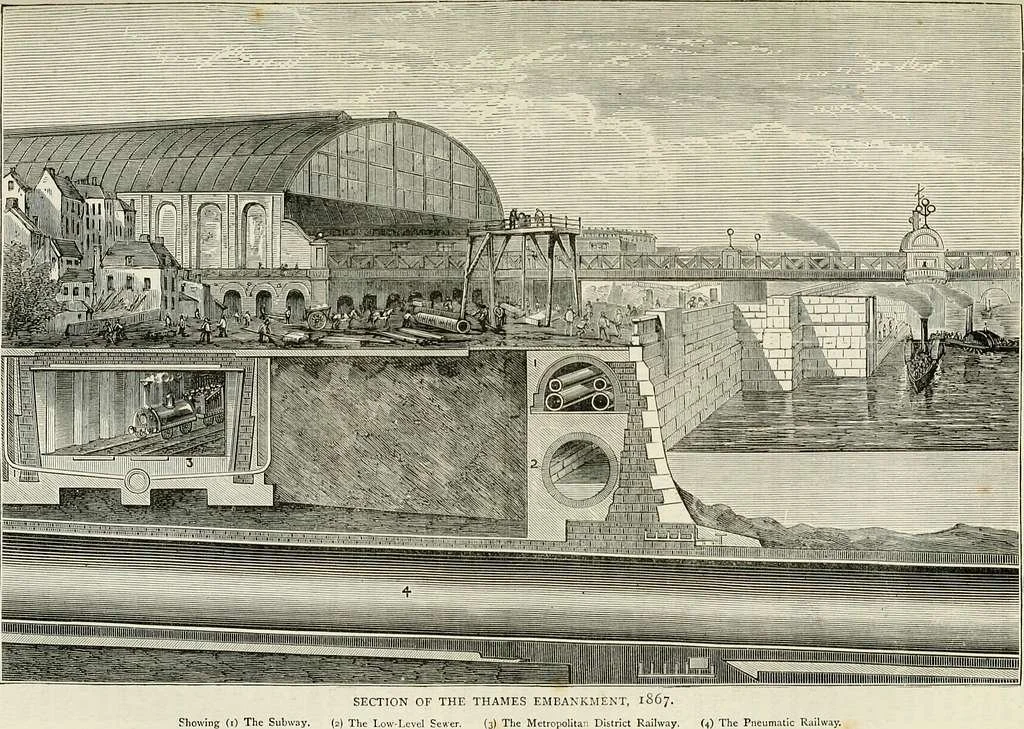
Image courtesy of Old and New London - a narrative of its history, its people, and its places (1873). More information about London’s “Great Stink” can be found here: https://www.thehistoryoflondon.co.uk/the-great-stink/
Drawing on Dickens’s fiction, journalism, and personal correspondence, Annetts explores how the dominant critical consensus emerged and suggests that it may overlook key aspects of Dickens’s social vision. Notably, Annetts points out that Dickens avoids directly addressing the environmental crisis of the Thames or the dramatic architectural reshaping of the city. Rather than focusing on physical infrastructure, Annetts discusses how in Our Mutual Friend, Dickens zeroes in on the shifting financial landscape and the persistent failures of the Poor Law—a decision Annetts interprets as deliberate and ideologically significant.
Through close attention to narrative structure, characterisation, and plot, Annetts shows how Dickens uses storytelling not to wallow in bleakness, but to model the potential for social change. His paper highlights the ways Dickens encourages empathy, cooperation, and cross-class understanding, positioning reform as a vital and achievable aspect of everyday life. In doing so, Annetts offers not just a fresh reading of Our Mutual Friend, but a broader reconsideration of Dickens’s later social vision.
Annetts’s presentation was vivid and an illuminating glimpse into the complexities of Victorian life. Engaging with it was both intellectually rewarding and deeply enjoyable.
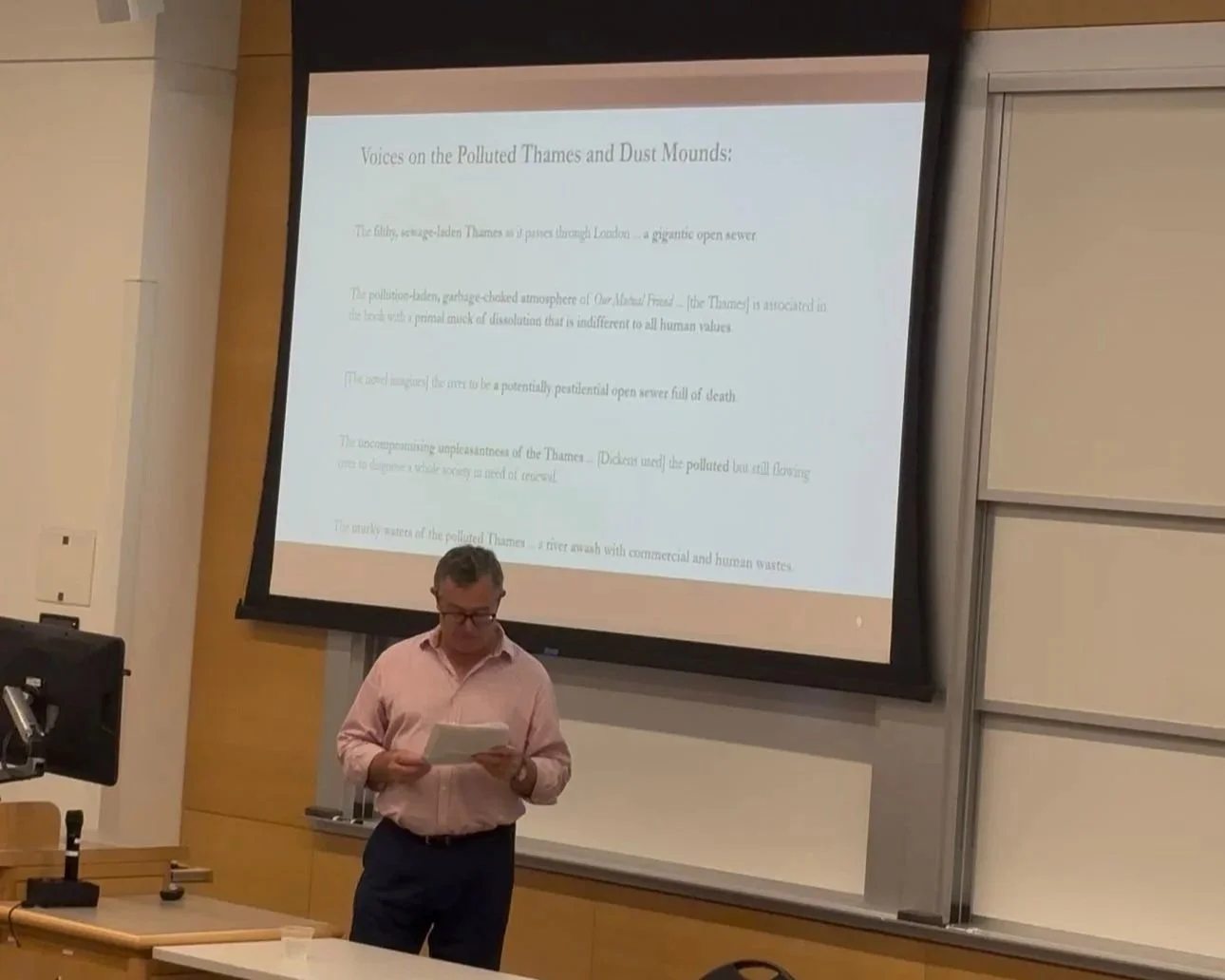
Ian Annetts at Boston University.
Emma Linford “Trapped in Fraud: Romance Fraud and Emotional Manipulation in Great Expectations”
I was incredibly honoured to travel from Hull in the UK to attend my first-ever Dickens Symposium, hosted by the Dickens Society in Boston, Massachusetts. As a new researcher stepping into this field, being invited to present was both exciting and humbling. The experience was inspiring from start to finish, and I truly enjoyed every moment—meeting fellow scholars, engaging in discussions, and being part of such a vibrant academic community.
Since this was my first time attending the Dickens Symposium in Boston, I wasn’t entirely sure what to expect. I was excited but also a little apprehensive—wondering how my own research on romance fraud and emotional manipulation in Dickens would fit within such a prestigious gathering of scholars. I anticipated rigorous discussion, but I was particularly curious about how interdisciplinary approaches might intersect with my own focus on linguistics, pragmatics, and emotional deception in literature.
Attending the Symposium was incredibly enlightening after listening to many wonderful speakers over the three-day event. Listening to a wide range of papers allowed me to situate my research within broader Dickens scholarship and see new connections I hadn’t considered. I was struck by how different analytical lenses—historical, linguistic, and psychoanalytic—can illuminate the subtleties of character and narrative. I came away with a renewed sense of purpose in my work, particularly in thinking about the ways Dickens’s writing manipulates readers’ emotions and social expectations. It inspired me to explore the interplay between language, deception, and emotional power more deeply in my ongoing research.
I presented a paper titled “Trapped in Fraud,” exploring Great Expectations through the lens of contemporary criminological theory, specifically romance fraud. Drawing on the work of criminologists Elizabeth Carter and Cassandra Cross (https://www.cambridge.org/core/books/language-of-romance-crimes/8A21A458A88FB527C6AA4BEB2D0A0D46), I examined how the novel anticipates modern patterns of emotional and financial deception.
My presentation argued that Miss Havisham is more than a jilted bride—she is a clear literary depiction of a romance fraud victim. Compeyson, her deceiver, uses tactics still recognised today: calculated manipulation, gaslighting, and financial exploitation disguised as romantic opportunity. This situates Great Expectations as an early case study in how language can be weaponised to exploit emotional vulnerability.
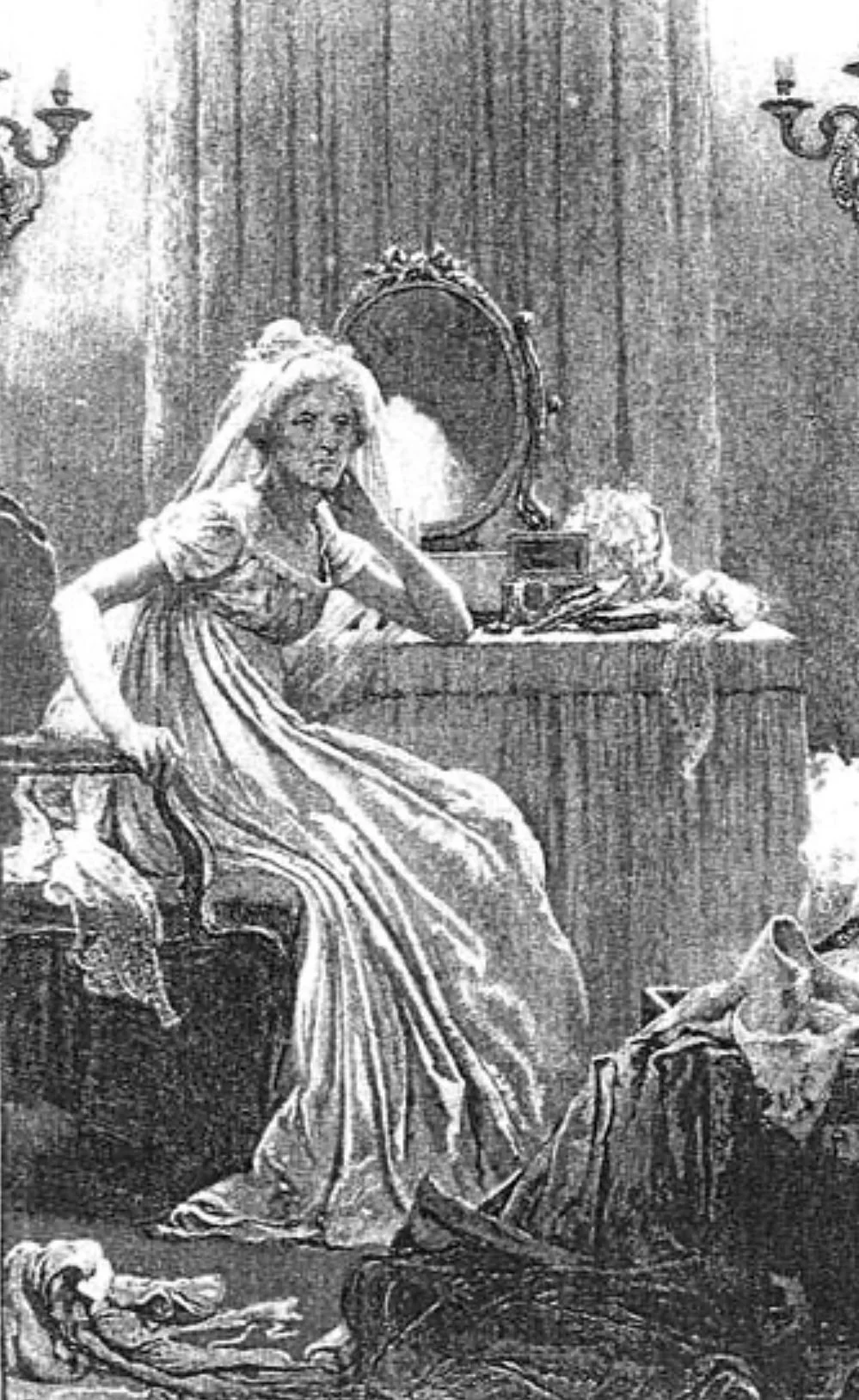
“Miss Havisham” by Charles Green, 1898, via The Victorian Web. Scanned image and text by Philip V. Allingham.
I also explored the legal and psychological dimensions of Miss Havisham’s experience, including the 19th-century view of engagement as a contractual obligation. The long-term effects of this emotional fraud ripple through the narrative, shaping Estella’s development and emotionally scarring Pip. Further, objects like the decaying wedding dress and the imprisoned Satis House symbolise Miss Havisham’s psychological entrapment.
My paper highlighted how Great Expectations offers a compelling, timeless portrait of the personal and social consequences of romance fraud—one still relevant in today’s digital age.
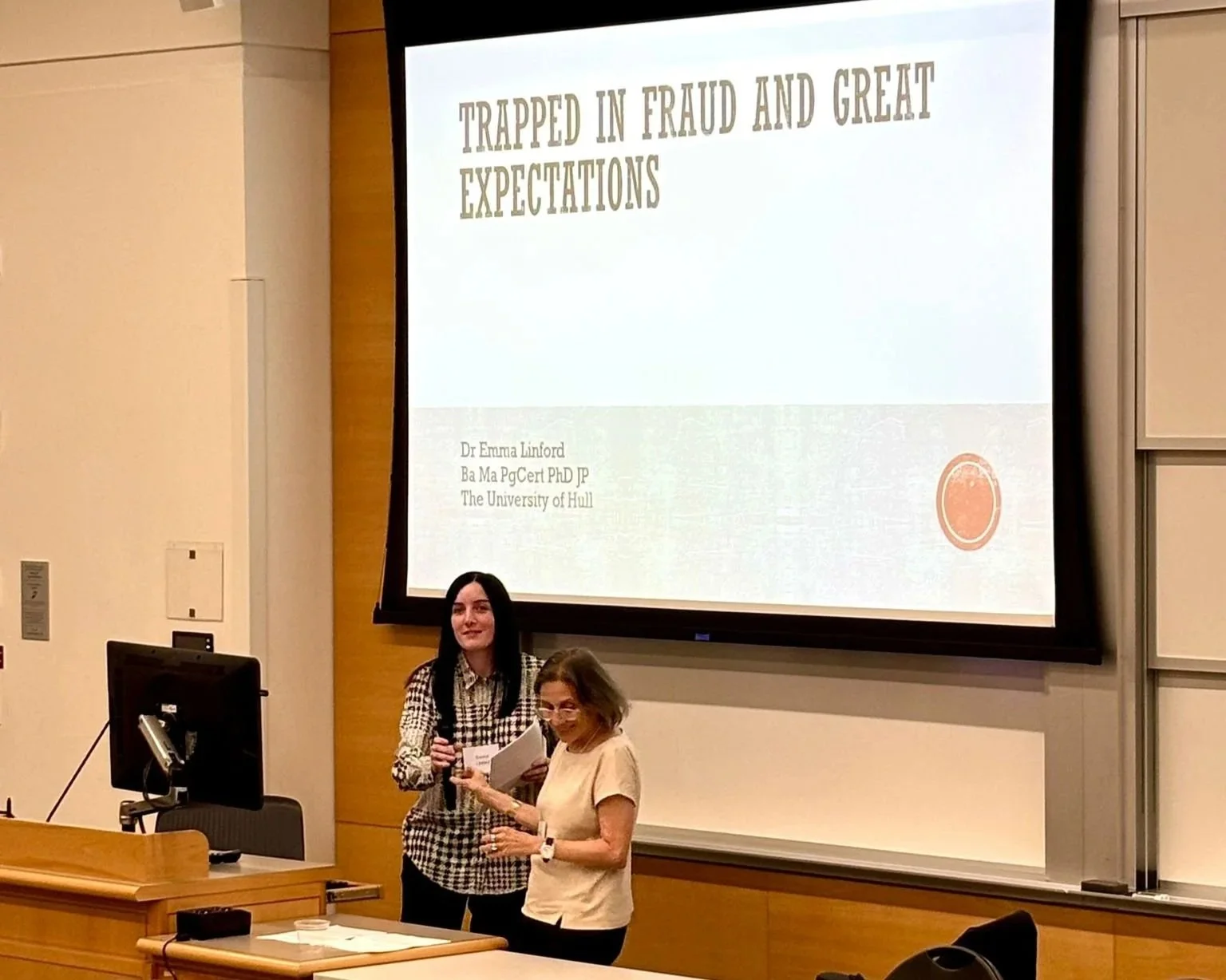
Emma Linford at Boston University.
Summary
This snapshot captures only a fraction of the Dickens Symposium—a few enriching days dedicated to literary analysis, interpretation, and the enduring legacy of Charles Dickens. The event stood as a powerful reminder of how deeply his work continues to resonate in our time. The Dickens Society’s next Symposium will be held in July 2026 at Aarhus University, Denmark. Attendees only need to be members of the Dickens Society to attend and enjoy yet another celebration of Dickens's works.
As this was my first Dickens Symposium, I was both excited and a little nervous, being relatively new to the field. Attending allowed me to see how my research on romance fraud and emotional manipulation fits within broader Dickens scholarship. Listening to a range of papers offered fresh perspectives and helped me refine my own thinking, particularly about the interplay between language, deception, and emotional power in his works. It was an invaluable experience for developing my studies and building confidence in my scholarship.
Works Cited
Dickens, Gerald. “Bonus Blog: Dickens at the Parker House.” On the Road with Gerald Dickens, 29 Nov. 2021, geralddickens.wordpress.com/2021/11/29/bonus-blog-dickens-at-the-parker-house/.