
Celebrating the Birthday of the Inimitable through UCSC’s Dickens Day of Writing
By Katie Bell
Katie is a high school English teacher in Georgia, USA, and the senior blog editor of The Cricket. Her PhD, on the influence of Dickens’s works on authors writing in the American South, was obtained from the University of Leicester, where she was an honorary researcher last year. She has also been a docent and researcher at the Charles Dickens Museum in London.
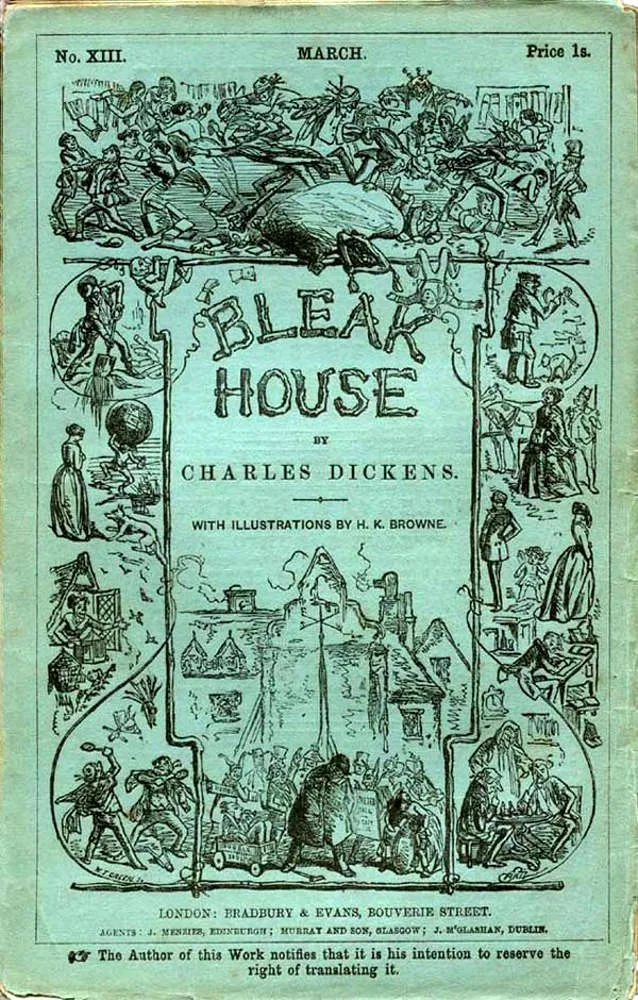
The Monthly Wrapper by Phiz, 1853.
Being a high school English teacher is a complicated profession for me, as I want to expose my students to classic literature that I feel is important to the human condition, but my classes have an extremely diverse range of reading levels, and I run the risk of shutting out my students who may be struggling with higher reading ranges. Of course, as a Dickens researcher and fan myself, my intent in taking on the class of British Literature was always to devote a whole unit to the Inimitable. Still, it becomes difficult when the average high school student no longer reads novels, but instead spends their time skimming small chunks of textual information from social media. My students always surprise me with their quick intellect and ability to work with harder concepts, but it can sometimes be a struggle to work with their reading stamina, which is much different from my own generation’s. So much of Dickens’s works are about children, and once my students can connect to his language (and penchant for run-on sentences), they do easily grasp the call to action that many of Dickens’s works are asking from the reader. To my great excitement, many of my students respond positively to his humor, which has always been one of my favorite aspects of Dickens.
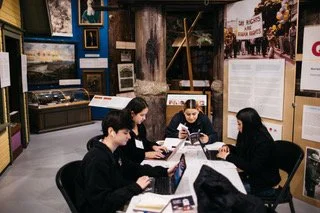
Christian Lehmann (who is also a member of the Dickens Society, is the former editor of its blog, and like me, is a Dickens scholar working with younger students), introduced me to the University of California Santa Cruz’s program, The Dickens Day of Writing, three years ago and I have signed up all 70 of my students to participate this year. UCSC has a website devoted to their program and allows high school teachers working with juniors and seniors to sign up their classes to participate. The resources for the DDoW come directly from their Dickens Project, “an international consortium comprising nearly 40 universities and colleges”, and through this, they are able to put on the DDOW, which “strive[s] to assist young scholars in examining the cultural relevance of nineteenth-century literature to the twenty-first-century world” (“About the Dickens Day of Writing”). Of putting on the program in the past, Lehmann expressed: “The Dickens Day of Writing has been an amazing way to strengthen bonds with the community by asking for different hosts. We've been fortunate to hold the DDoW at the Cleveland Museum of Art, where the docents curated a 19th-century tour for us. We've also held our event at the Cleveland Public Library, where we were given access to the Best Buy Teen Tech Center. The students are always a bit nervous to dive into Dickens, someone that they have only vaguely heard about, but after a few hours discussing the text, they are eager—after lunch—to begin writing critically or creatively.” Lehmann, like me, has discovered that the key to connecting with students is through food. Dickens, who wrote so eloquently about the power of food and drink, would likely agree.
“The Dickens Day of Writing is both a writing retreat and a writing competition designed to support junior and senior high school students in their futures as college students and professionals. By reflecting on a short essay by Charles Dickens, the students will reinforce skills learned in the classroom, such as critical reading, analytical reasoning, argumentative writing, creative production, and cultural history, to prepare them for life beyond high school.”
West Cliff Creative via Dickens Project.
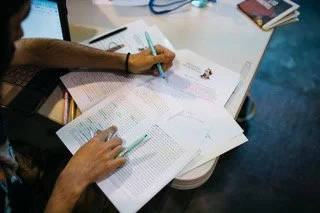
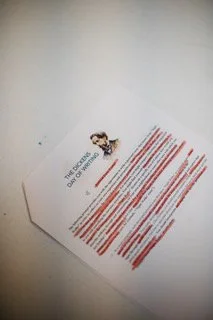
This year, the DDoW will focus on the opening of Bleak House, which likens the British legal system to the fog and mud of London. The DDoW’s Creative Essay Prompt describes Bleak House, as using “very few proper nouns or named characters, a combination of sentences and evocative sentence fragments, [...] and [...] different scales of time and space” in the introductory chapter, which provides high school students a rich (though minimal in length) text to engage with for their study. Teachers get to design how they will approach the project in a way that works best for their students, but most classes begin with an introduction to Dickens (if that has not already been addressed in the class), followed by engaging with videos that UCSC puts together themselves from established Dickensian scholars, and then the students move to reading the chapter and drafting writing on either a analytic or creative prompt, written by the DDoW. DDoW also generously donates a stipend for teachers to use for supplies. In my case, we will be having a birthday party to celebrate Dickens, while we write (sadly without any goose or plum pudding, but, instead, the twenty-first equivalent: pizza and donuts).
West Cliff Creative via Dickens Project.
The culmination of the day(s) spent writing is that each student (if they choose) can have their finished piece published in a printed volume by UCSC. For most of my students, this is the first time their work has been honored in this way, and the prospect of it has been the most exciting to them (after the food, of course). Lehmann concurred, writing to me that, “One of the best parts of the DDoW actually comes several months after the day when we receive a big box with all the published essays. Students hold them up, show them to friends, and point out their individual essays. I've even had several parents ask me for extra copies.” The students at Dunwoody High School graduate in mid-May, and it is always my aim to have the journal in their packet of letters that the school gives to students as they walk across the stage to shake hands with the principal and receive their diplomas.
West Cliff Creative via Dickens Project.
I came to Dickens’s works as a teenager myself and instantly connected with his voice. I found myself coming home to race to my copy of David Copperfield to find out what happened next and to immerse myself in his language, which provided me with a much-needed escape from my life at that time. While I know that not every student will feel the same affinity for him as I did and do, as a teacher, my goal is to expose my students to different voices throughout literature with the hopes that they can find a connection. A great teacher that I met through the Dickens Society once told me that the act of reading becomes life-changing when we find a connection in what we read. Through the DDoW, my students get the opportunity to make that connection through a thoughtfully designed program led by academics in the field. Now, if only I could find a similar program for Shakespeare, I’d be in good shape for the rest of the semester.
Works Cited:
“About the Dickens Day of Writing.” University of California Santa Cruz, nd,
https://teachers.ucsc.edu/dickens-day-of-writing/.
Browne, Hablot K. (Phiz). The Monthly Wrapper. 1853, The Victorian Web, Scanned image
by George P. Landow, https://victorianweb.org/art/illustration/phiz/bleakhouse/41.html.
Lehmann, Christian. Personal Interview. 30 January 2026.
West Cliff Creative. [Dickens Project]. (2024, February 7). [Photographs]. Flickr.
https://www.flickr.com/photos/dickensproject/albums/72177720324207638/.